
Carbon Reduction Plan
Prepared in accordance with Procurement Policy Note 006
Supplier name: Paratus Partners Ltd, trading as Allied Match (Company No. 11026739)
Publication date: 12 November 2026
Reporting period covered: 1 October 2025 – 30 September 2026
Review / expiry date: 12 November 2027 (12 months from publication)
Published at: https://www.paratuspartners.com/carbon-reduction-plan
Commitment to achieving Net Zero
Paratus Partners Ltd is committed to achieving Net Zero emissions by 2050.
This is in line with the UK Government Net Zero target set by the Climate Change Act 2008 (2050 Target Amendment) Order 2019.
This commitment covers all UK operations of Paratus Partners Ltd, including services delivered under the Allied Match trading name, and supports the NHS ambition to reach Net Zero for the emissions it can influence by 2045.
Baseline Emissions Footprint
Baseline emissions are a record of the greenhouse gases that have been produced in the past and were produced prior to the introduction of any strategies to reduce emissions. Baseline emissions are the reference point against which emissions reduction can be measured.
| Baseline Year: 2024 | 1 January 2024 – 31 December 2024 |
| Additional details relating to the baseline emissions calculations | 2024 is our first full assessment of organisational emissions and is used as our baseline. It covers Scope 1, Scope 2 and the required subset of Scope 3 emissions for all UK operations of Paratus Partners Ltd, including those trading as Allied Match. Emissions were calculated using the GHG Protocol Corporate Standard and the UK Government conversion factors for company reporting (2024). Our emissions are driven mainly by staff travel between care visits and assignments, business travel, employee commuting and office energy use. |
Baseline year emissions
| Emissions | Total (tCO2e) |
|---|---|
| Scope 1 | 24.7 |
| Scope 2 | 16.8 |
| Scope 3 (Included Sources) | 142.3 |
| Total Emissions | 183.8 |
Breakdown of baseline emissions
Scope 1 (24.7 tCO2e) is fuel used in company vehicles.
Scope 2 (16.8 tCO2e) is purchased electricity for office premises (location-based).
Scope 3 sources are shown below.
| Scope 3 included source (PPN 006 required subset) | Baseline 2024 (tCO2e) |
|---|---|
| Upstream transportation and distribution (Category 4) | 11.2 |
| Waste generated in operations (Category 5) | 6.3 |
| Business travel (Category 6) | 68.9 |
| Employee commuting (Category 7) | 52.3 |
| Downstream transportation and distribution (Category 9) | 3.6 |
| Total Scope 3 (Included Sources) | 142.3 |
Current Emissions Reporting
Reporting Year: 2025/26 – 1 October 2025 – 30 September 2026
| Emissions | Total (tCO2e) |
|---|---|
| Scope 1 | 24.2 |
| Scope 2 | 2.0 |
| Scope 3 (Included Sources) | 79.1 |
| Total Emissions | 105.4 |
| Source (2025/26) | tCO2e |
|---|---|
| Scope 1 – company vehicles used by supervisors and coordinators | 21.6 |
| Scope 1 – heating share of serviced office | 2.6 |
| Scope 2 – electricity share of serviced office (location-based) | 2.0 |
| Scope 3 – business travel: care staff mileage between visits, rail and taxi (Cat. 6) | 43.4 |
| Scope 3 – employee commuting, including care staff travelling to shift-based packages (Cat. 7) | 32.0 |
| Scope 3 – upstream transportation and distribution: PPE, uniforms and supplies (Cat. 4) | 3.0 |
| Scope 3 – waste generated in operations (Cat. 5) | 0.5 |
| Scope 3 – downstream transportation and distribution (Cat. 9) | 0.2 |
| Total | 105.4 |
Current-year emissions have been estimated using average-data methods permitted by the reporting standard: staff mileage by role and typical weekly travel, office energy on a floor-area share of our serviced premises, and spend-based estimates for supplies. Scope 3 covers the same five required categories as the baseline.
Part of the difference from the 2024 baseline reflects this more detailed, activity-based method rather than operational change alone. We will review the baseline in line with the GHG Protocol base-year recalculation guidance at our next annual update, and will move to measured data (mileage claims, utility data and fuel records) for future reporting years.
Progress since our 2025 plan
This is our second Carbon Reduction Plan. Our first plan, published in November 2025, set our 2024 baseline of 183.8 tCO2e and our commitment to Net Zero by 2050. This update:
- adds our first full year of reporting against the baseline (1 October 2025 – 30 September 2026);
- restates our 2030, 2040 and 2050 targets so that each is calculated correctly from the 2024 baseline (the 2025 plan contained calculation errors in its target figures, which are corrected here);
- separates the reporting period from the publication date, so that the plan meets the PPN 006 timing requirements; and
- is published on a dedicated page of our website.
Our underlying commitments are unchanged: a 50% reduction by 2030, an 80% reduction by 2040 and Net Zero by 2050.
Emissions reduction targets
In order to continue our progress to achieving Net Zero, we have adopted the following carbon reduction targets.
We project that carbon emissions will decrease over the next five years to 91.9 tCO2e by 2030. This is a reduction of 50%.
| Target year | Reduction against 2024 baseline | Target emissions (tCO2e) |
|---|---|---|
| 2030 | 50% | 91.9 |
| 2040 | 80% | 36.8 |
| 2050 | Net Zero (at least 90% reduction, with residual emissions removed) | 18.4 or less before removals |
Progress against these targets can be seen in the graph below:
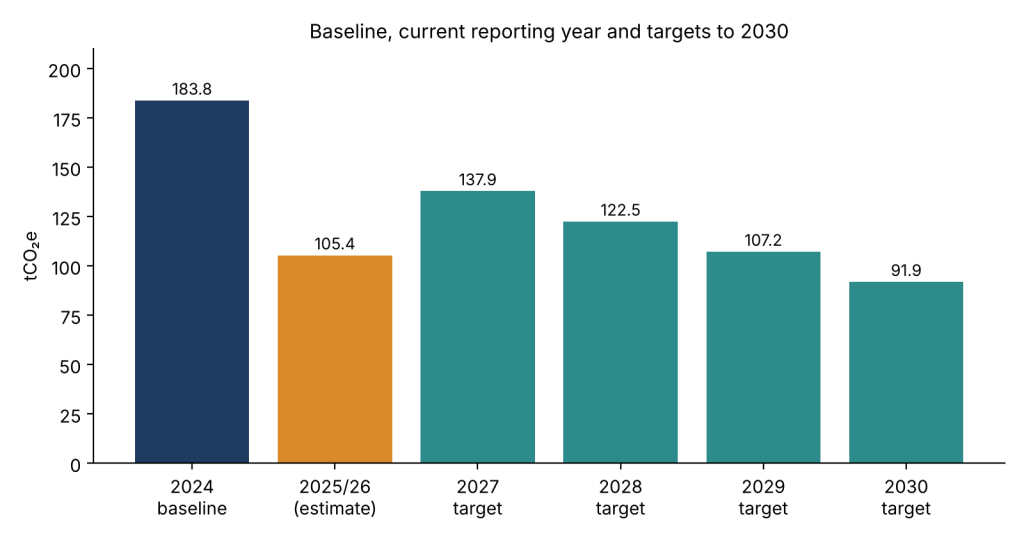
Interim pathway (tCO2e): 2025 – 168.5; 2026 – 153.2; 2027 – 137.9; 2028 – 122.5; 2029 – 107.2; 2030 – 91.9.
Carbon Reduction Projects
Completed Carbon Reduction Initiatives
The following environmental management measures and projects have been completed or implemented since the 2024 baseline. The carbon emission reduction achieved by these schemes equate to 6.1 tCO2e, a 3.3% reduction against the 2024 baseline and the measures will be in effect when performing the contract.
- Digital operations: care records, timesheets, rostering and compliance records moved to a secure, cloud-hosted digital platform, removing paper processes and on-premise servers (estimated 2.3 tCO2e a year).
- Office energy: LED lighting throughout office premises, programmable heating controls and a recycling programme for office and IT waste (estimated 1.9 tCO2e a year).
- Travel: virtual-by-default internal and client meetings, online training delivery, cycle-to-work scheme and support for staff using public transport (estimated 1.9 tCO2e a year).
- Workforce deployment: digital scheduling that groups visits and assignments geographically and prioritises staff living locally, reducing travel between calls.
Future carbon reduction initiatives
In the future we hope to implement further measures such as:
- Switching all office premises to a 100% renewable electricity tariff.
- Replacing company vehicles with electric or hybrid vehicles as leases end.
- Using route and roster data to cut mileage per visit year on year.
- Asking key suppliers for their own carbon reduction commitments as part of supplier review.
Environmental Management Measures for Contract Performance
When performing contracts under the RM6380 framework, Paratus Partners Ltd will apply the following measures:
Digital-first operations
- Paperless workflows: care records, medication administration records, visit logs, timesheets and compliance records are held on our secure, ISO 27001-certified digital platform.
- Remote oversight: real-time alerts and digital care records let supervisors review care remotely, reducing unnecessary site visits.
- Virtual training: mandatory and refresher training is delivered online wherever the subject allows.
Sustainable workforce deployment
- Local deployment: staff are matched to placements and packages close to where they live wherever possible.
- Efficient rostering: visits are scheduled in geographic runs to cut mileage between calls.
- Sustainable travel: cycle-to-work scheme and support for staff using public transport.
Office, supply chain and waste
- Cloud infrastructure: UK-hosted cloud systems in place of on-premise servers.
- Waste: recycling of office and IT waste, and reuse or refurbishment of IT equipment where possible.
- Suppliers: preference for local suppliers and those with their own carbon reduction commitments.
Monitoring and Reporting
- Annual update: we will recalculate our emissions each year using the GHG Protocol and the latest Government conversion factors, and republish this plan within six months of each reporting period end.
- Better data: from the 2026/27 reporting year we will use measured data (staff mileage claims, company vehicle fuel records and office utility data) in place of estimates.
- Baseline review: we will review the 2024 baseline under the GHG Protocol base-year recalculation guidance once measured data is available.
- Contract reporting: on request, we will report emissions attributable to individual call-off contracts to the buying organisation.
Supporting the NHS Net Zero Commitment
The NHS has committed to reach Net Zero by 2040 for the emissions it controls directly and by 2045 for those it can influence, including those of its suppliers. As a supplier of care and support staff, we contribute by:
- keeping travel by our deployed staff to a minimum through local matching and efficient rostering;
- using digital records to reduce paper and administrative waste for the services we support;
- making sure deployed staff know and follow the sustainability practices of the NHS organisations they work in; and
- sharing our emissions data with NHS buyers to support their supplier carbon reporting.
Governance and Accountability
- Board ownership: the directors approve this plan and review progress against it at least once a year.
- Named responsibility: a director holds responsibility for delivering the plan, supported by our compliance function.
- Staff engagement: environmental awareness forms part of staff induction, and staff are encouraged to suggest ways to reduce travel and waste.
Declaration and Sign Off
This Carbon Reduction Plan has been completed in accordance with PPN 006 and associated guidance and reporting standard for Carbon Reduction Plans.
Emissions have been reported and recorded in accordance with the published reporting standard for Carbon Reduction Plans and the GHG Reporting Protocol corporate standard1 and uses the appropriate Government emission conversion factors for greenhouse gas company reporting2.
Scope 1 and Scope 2 emissions have been reported in accordance with SECR requirements, and the required subset of Scope 3 emissions have been reported in accordance with the published reporting standard for Carbon Reduction Plans and the Corporate Value Chain (Scope 3) Standard3.
This Carbon Reduction Plan has been reviewed and signed off by the board of directors (or equivalent management body).
Signed on behalf of the Supplier:

Name: Wambui Kibicho
Position: Head of Compliance and Legal / Director
Date: 12 November 2026